 |

Sokee
combines oriental beauty, ancient craftsmanship and contemporary
design in cabinetry.
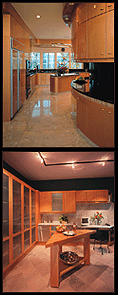 Exotic,
beautiful, and unique are adjectives often used to describe the
Orient, and Sokee cabinets. According to Sokee U.S. National Sales
Manager, "American consumers can get high-end cabinets incorporating
an oriental approach to modern design. What makes these cabinets
desirable is their combination of unique craftsmanship, design,
materials and finishes." Exotic,
beautiful, and unique are adjectives often used to describe the
Orient, and Sokee cabinets. According to Sokee U.S. National Sales
Manager, "American consumers can get high-end cabinets incorporating
an oriental approach to modern design. What makes these cabinets
desirable is their combination of unique craftsmanship, design,
materials and finishes."
Developed
in the European frameless tradition, Sokee cabinets are made with
the finest materials available in their modern factory in Nagoya,
Japan. For example, Sokee cabinet interiors are covered with vertical
grade high-pressure laminate, which virtually lasts a lifetime.
All shelves in Sokee cabinets are ¾" thick with 180° rounded edges
and are also covered in laminate. And, every sink cabinet comes
with an embossed stainless steel bottom for long life and easy care.
The same stainless material can be ordered on all cabinet shelves
and drawer bottoms.
"Quality long life construction is only the beginning of the Sokee
story. The real difference that every designer and consumer sees
immediately is the finish and materials used in Sokee door designs."
Sokee
doors are available in contemporary flat doors, recessed panel and
frame doors, or more traditional raised panel doors. From these
basic door styles, Sokee will make curved doors, decorative grill
doors, angled "Z" doors and doors with other unusual custom detailing.
Traditional woods such as oak and maple are available. More unusual
woods such as elm, beech, and very fine grained cherry are also
used. Other woods available, some of which are exclusive to Japan,
include:
- Tamamoku,
which is cut from the burl of the tree, has an elegant grain pattern
that is both complicated yet beautiful. This grained wood is considered
extremely valuable and is used almost exclusively in high-end
furniture and expensive building interiors.
- Anigure,
a straight grained white African wood with a horizontal texture.
When Sokee's famous piano finish is applied to this wood, the
natural beauty that shows through is both exquisite and exotic.
- Tachidamo,
a Japanese wood that is cut from the burl of the tree and exhibits
a very unusual dense grain pattern. More three-dimensional than
other woods, this exotic wood shows its true glory when piano
finished.
- Japanese
Cypress, one of the most favored and finest materials used in
Japanese architecture, is often chosen for its very fine grain
and special fragrance. Cypress wood is also well known in Japan
because it is frequently enhanced by an ancient process called
"wood burning" to give the wood texture followed by special sanding
and polishing.
- Straight
Grained Japanese Cedar, used in temple, shrine and ornamental
bridge construction for thousands of years, is known for its resiliency
to moisture, long life and beautiful color and grain. Sokee craftsmen
use strips of cedar woven into a diamond pattern to achieve a
unique three-dimensional look to make Ajiro doors. Ajiro describes
the ancient weave pattern that exemplifies traditional Japanese
culture. This weave pattern has been used in rooftops and sliding
doors in Japanese architecture for centuries.
- Spruce and
spruce with cherry bark accents are perfect examples of using
woods native to Japan for different looks. Using spruce, carefully
chosen for grain and color, the frames for cabinet doors and drawer
fronts are cut and molded. Doors are assembled using frame pieces,
spruce center panels and thin dark cherry spline pieces in each
corner. Drawer fronts are assembled the same way using either
spruce or cherry bark center panels. The unusual cherry bark drawer
center panels are all different as nature creates the intricate
and beautiful patterns.
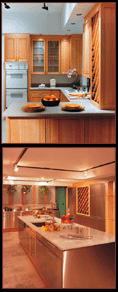 Sokee's
parent company has been involved in high-tech stainless steel products
and fabrications for 50 years. This manufacturing expertise is apparent
in the quality and appearance of Sokee's stainless offering. Stainless
can also be combined with Beech to add warmth to the clean, stark
lines of a stainless installation. Add to this perforated stainless
mesh encapsulated in glass inserts for doors and you have a truly
unique look. Sokee's
parent company has been involved in high-tech stainless steel products
and fabrications for 50 years. This manufacturing expertise is apparent
in the quality and appearance of Sokee's stainless offering. Stainless
can also be combined with Beech to add warmth to the clean, stark
lines of a stainless installation. Add to this perforated stainless
mesh encapsulated in glass inserts for doors and you have a truly
unique look.
Sokee finishes are as varied and diverse as the Orient. One of the
most unusual and sophisticated finishes Sokee applies evolved from
an ancient Japanese craft called "Urushi". This finish over the
centuries has been applied not only to fine furniture but also to
musical instruments.
Europeans, after
World War II, attempted to copy this fine finish and called it "Japaneserre".
They tried to accomplish it with coats and coats of lacquer only
to fail. What they did not know is that after applying the lacquer,
it is rubbed with ashes many times until the surface is absolutely
and perfectly smooth and even. Then it is polished with an oil based
sanding material until it has a mirror like finish.
This ancient Japanese art is still practiced today, but Sokee has
invented special finishes that can be used in larger production
situations to achieve virtually the same results. This finish is
applied to Sokee cabinetry…layer after layer, polishing after polishing…to
produce cabinetry that looks and feels like a fine piano finish.
Sokee also offers a wide choice of internal and external accessories
to add convenience and function to any kitchen.
Click
here to visit Sokee's site
|




 Copyright © 2016 Dewhurst & Associates. All rights reserved.